Contents

Top
Command Line Options
Keyboard Shortcuts
Configuration File
Main Window Settings
Wrap Settings
Export Settings
Auto Probe Settings
General Settings

Jcalin

G-Code Ripper Home Download Scorch Works Home

Command Line Options

Usage python g-code_ripper-XXX.py [-g file ]
or
g-code_ripper-XXX.py [-g file ]
-c
(or --config_file)
Configuration file to read
-g
(or --gcode_file)
g-code file to read
-d
(or --defdir)
Default open/save directory
-h
(or --help)
print syntax help to console window.
Example
(Using python script with
preinstalled python distribution)
python g-code_ripper-XXX.py -g my_file.ngc
Example
(Using precompiled
Windows executable)
g-code_ripper-XXX.exe -g my_file.ngc

Keyboard Shortcuts

F1 Open the Help dialog box. (There is nothing in the help except a reference back to the web page and my e-mail address)
F2 Opens General Settings Window
F5 Refresh display

Configuration File

g-code-ripper_config.ngc
or
.gcoderipperrc
When G-Code Ripper starts up the directory in which G-Code Ripper starts in is searched for a file named "g-code-ripper_config.ngc". If the file is found it is read and all of the G-Code Ripper options are set according to the settings saved in the config file. After searching for the config file in the current directory the users home directory is searched for "g-code-ripper_config.ngc" or ".gcoderipperrc" if either of these are found it will be used as the default settings. Only the first config file found is read.

To create a config file with your preferred options for startup just open G-Code Ripper and change the settings to your liking and click the save button next to configuration file in the settings window.

Main Window

G-Code Ripper - Main Window

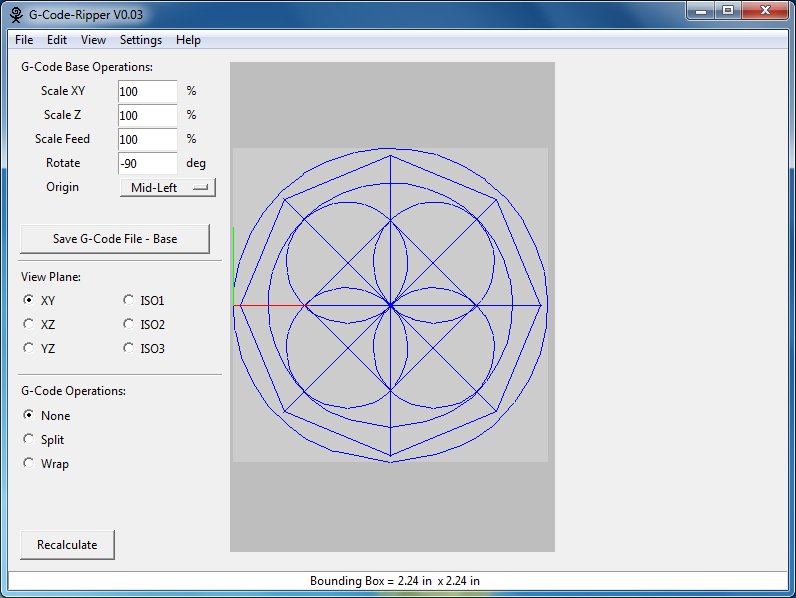
G-Code Base Operations: This section contains basic operations that are performed prior to any G-Code Operations selected below. The base operations are always applied before the additional operations.
Scale XY Sets the scaling percentage for X and Y axes to be applied to the input g-code file.
Scale Z Sets the scaling percentage for Z axis to be applied to the input g-code file.
Scale Feed Sets the scaling percentage for feed rate to be applied to the input g-code file.
Rotate Sets the angle in degrees to rotate input g-code file.
Origin The origin determines the relative location of the g-code x and y zero location. The current location of the origin is displayed in the display window as a red and green lines. The red and green lines follow the RGB convention Red is the x-axis, Green in the y-axis.
Save G-Code File Base (Button) This button results in saving the g-code with only the option above the button being applied (scale, rotate, origin). Any further options from below or on the right side of the image are not applied.
View Plane: This section contains a variety of view plane orientations only one of the options is active at any time.
G-Code Operations: In this section the additional operations that can be applied to the g-code can be selected.
None No operations are performed in addition to the base operations.
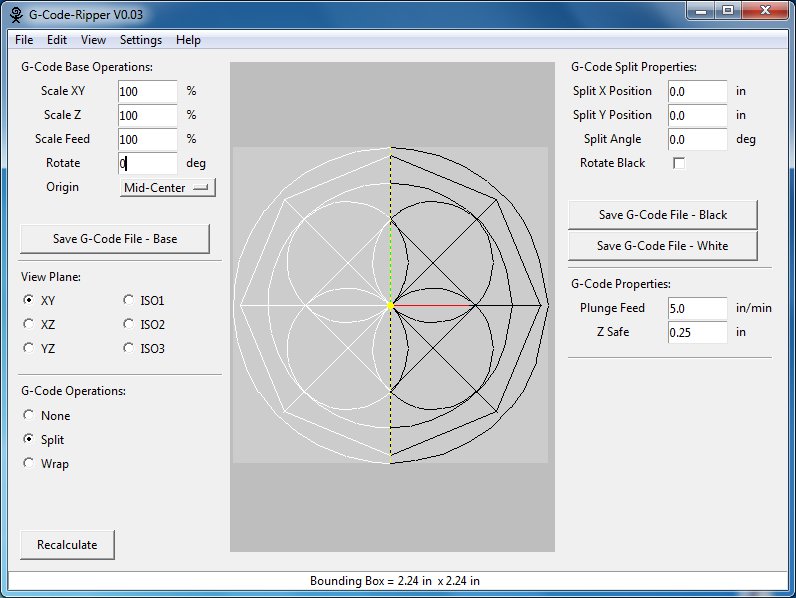
Split The G-Code is split along a line creating two g-code programs that can be run independently.
Wrap One of the G-Code linear axes (X or Y) is mapped to a rotary axis (A or B) for machining on a cylinder.

G-Code Split Properties

jcalin

Input Field Description
Split X Position X position of the splitting line. (i.e. the line on which the g-code is divided into two parts.) The X position is measured from the origin set in the base operations section.
Split Y Position Y position of the splitting line. (i.e. the line on which the g-code is divided into two parts.) The Y position is measured from the origin set in the base operations section.
Split Angle The angle of the splitting line.
Rotate Black The rotate black setting determines whether one of the two sides of the split will be rotated by 180 degrees. Rotating 180 degrees allows the stock to be rotated 180 degrees in the machine to machine the second half. Doing this process can effectively increase size of designs that can be cut by a given machine.
Save G-Code File-Black (Button) This button saves the g-code displayed as black in the canvas.
Save G-Code File-White (Button) This button saves the g-code displayed as white in the canvas.
Plunge Feed Because the g-code is being split additional cut starts and stops are required. During the additional starts the tool needs to plunge into the stock material. The plunge feed sets the feed rate for these new moves into the stock material.
Z Safe Because the g-code is being split additional cut starts and stops are required. After one of the additional cut stops the tool needs to move to a safe position for rapid movement. The Z Safe setting sets the z position of this z location that is safe for rapid motions.

Jcalin

This article explores the artistic identity of Jcalin, the technical aspects of their creations, and the community dynamics surrounding this specific genre of digital media. The Artistic Style of Jcalin

— Unlikely; maybe JCALIN = Journal of Computer-Aided...? Not standard.

Setting up the base characters (avatars) and scaling them to massive proportions relative to the "props" (cars, buildings, trees).

Jcalin represents a modern digital artisan who has mastered the technical requirements of 3D rendering to serve a specific, dedicated audience. By blending realism with fantasy scale, they have become a recognizable name in the niche world of giantess art, proving that even the most specific interests can foster vibrant creative output and community support in the digital age. jcalin

Years passed, and Julian became a legend in his own right. Sailors and travelers would whisper stories of the enigmatic island of Jcalin, where a mysterious adventurer had disappeared into the heart of the Pacific. Some said Julian had found treasure, while others claimed he had discovered a hidden world.

One fateful day, after months at sea, Julian finally stumbled upon Jcalin. As he anchored his ship and set foot on the island's pristine shores, he was struck by its breathtaking beauty. The island was a lush oasis, teeming with exotic wildlife, crystal-clear waters, and powdery white sand beaches.

For those interested in the "how-to" behind this style of content, the process typically involves several layers of digital production: This article explores the artistic identity of Jcalin,

Unlike more abstract or cartoonish digital art, Jcalin’s style leans toward semi-realism, focusing on skin textures, lighting, and realistic clothing physics to make the surreal scale feel more grounded.

In the expansive world of digital subcultures, the keyword refers most prominently to a digital artist and content creator known for specializing in giantess-themed artwork and 3D modeling. Often associated with platforms like DeviantArt and various niche art forums, the work of Jcalin has carved out a distinct space in the realm of "size difference" art.

Jcalin’s portfolio is characterized by high-resolution 3D renders that explore the visual contrast between massive, powerful figures and minuscule environments. Using sophisticated rendering software—likely tools such as or Poser —the creator builds intricate scenes that emphasize: Setting up the base characters (avatars) and scaling

With that, I can give a precise citation or summary.

Over time, Julian made Jcalin his home, and the island became his sanctuary. He spent his days exploring, mapping, and uncovering the secrets of the island. As he settled into his new life, Julian began to notice strange occurrences. The island seemed to be responding to his presence, as if it were alive. Plants bloomed brighter, animals gathered around him, and the stars shone brighter in the night sky.

In the heart of the Pacific Ocean, there existed a small, uncharted island known as Jcalin. The island was a mystery to the outside world, and its existence was only whispered among sailors and travelers who dared to venture into the vast expanse of the ocean.

The hallmark of Jcalin’s work is the use of extreme low-angle shots to enhance the sense of height and power of the central figures.
Export (DXF, CSV) Settings

jcalin

Input Field Description
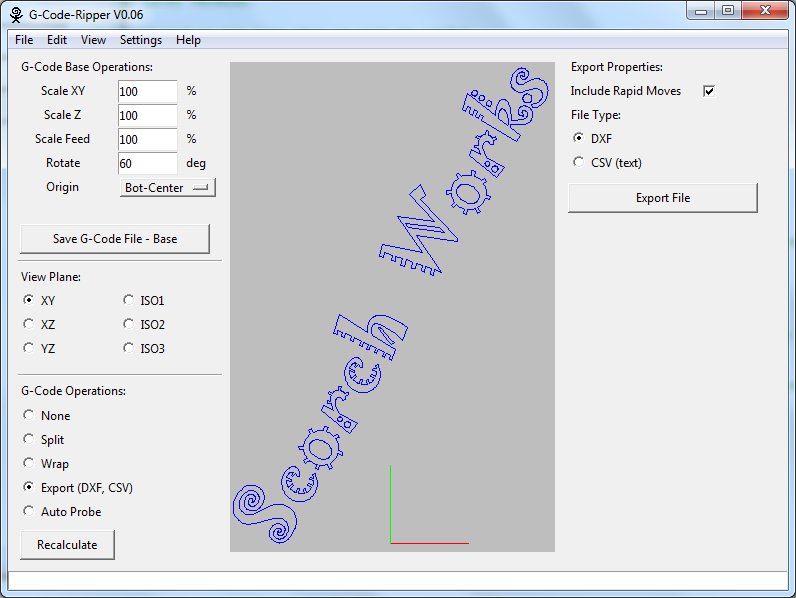
Include Rapid Moves If selected the rapid moves will be included in the exported output.
File Type Select the type of file to be exported

Auto Probe Settings

jcalin

Input Field Description
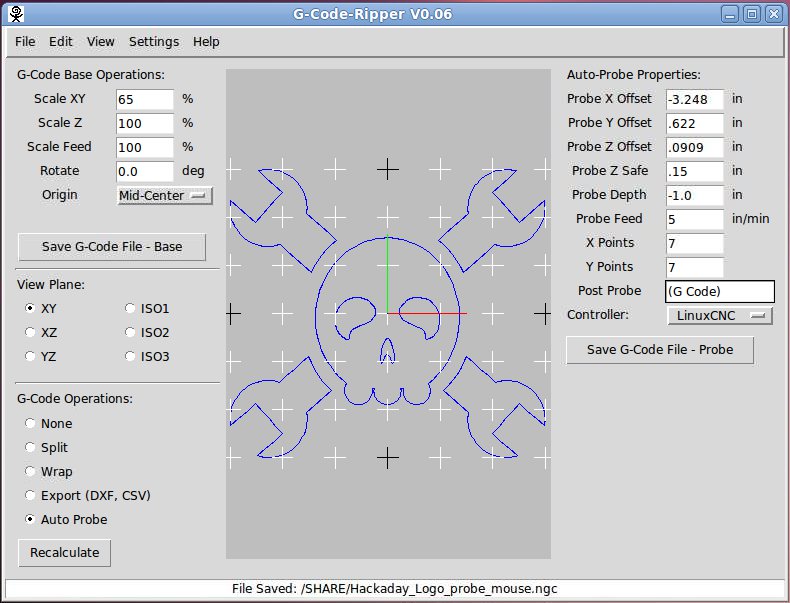
Probe X Offset X distance from the tool to the probe.
(if the tool is the probe this should be set to zero)
Probe Y Offset Y distance from the tool to the probe.
(if the tool is the probe this should be set to zero)
Probe Z Offset Z distance from the tool to the probe.
(if the tool is the probe this should be set to zero)
(It is best to keep this value as close to zero as possible to prevent crashing the tool or probe)
Probe Z Safe This is the safe Z height when probing (When the probe is over the work piece).
Be aware of where the tool will be when the probe is at this position to avoid cashing the tool.
Probe Depth Max Depth the probe will travel attempting to detect the work piece.
If the probe travels to this position and does not detect the part an error will occur.
Probe Feed The feed rate for the probe when it is lowering to detect the part.
X Points This is the number of points that form the grid of probe points in the X direction.
Points that are not needed (too far from tool path) are displayed as black in the preview canvas and will not probed.
Y Points This is the number of points that form the grid of probe points in the Y direction.
Points that are not needed (too far from tool path) are displayed as black in the preview canvas and will not probed.
Post Probe This is a text entry field for any G-Codes that should be executed prior to the pause between probing and cutting.
(If you want to swap the probe head for the tool head you may want to raise to a specified Z height (i.e. G0Z5.0)
Controller Set the CNC controller to be used. LinuxCNC and MACH3 are supported. They require different codes for probing etc.

This article explores the artistic identity of Jcalin, the technical aspects of their creations, and the community dynamics surrounding this specific genre of digital media. The Artistic Style of Jcalin

— Unlikely; maybe JCALIN = Journal of Computer-Aided...? Not standard.

Setting up the base characters (avatars) and scaling them to massive proportions relative to the "props" (cars, buildings, trees).

Jcalin represents a modern digital artisan who has mastered the technical requirements of 3D rendering to serve a specific, dedicated audience. By blending realism with fantasy scale, they have become a recognizable name in the niche world of giantess art, proving that even the most specific interests can foster vibrant creative output and community support in the digital age.

Years passed, and Julian became a legend in his own right. Sailors and travelers would whisper stories of the enigmatic island of Jcalin, where a mysterious adventurer had disappeared into the heart of the Pacific. Some said Julian had found treasure, while others claimed he had discovered a hidden world.

One fateful day, after months at sea, Julian finally stumbled upon Jcalin. As he anchored his ship and set foot on the island's pristine shores, he was struck by its breathtaking beauty. The island was a lush oasis, teeming with exotic wildlife, crystal-clear waters, and powdery white sand beaches.

For those interested in the "how-to" behind this style of content, the process typically involves several layers of digital production:

Unlike more abstract or cartoonish digital art, Jcalin’s style leans toward semi-realism, focusing on skin textures, lighting, and realistic clothing physics to make the surreal scale feel more grounded.

In the expansive world of digital subcultures, the keyword refers most prominently to a digital artist and content creator known for specializing in giantess-themed artwork and 3D modeling. Often associated with platforms like DeviantArt and various niche art forums, the work of Jcalin has carved out a distinct space in the realm of "size difference" art.

Jcalin’s portfolio is characterized by high-resolution 3D renders that explore the visual contrast between massive, powerful figures and minuscule environments. Using sophisticated rendering software—likely tools such as or Poser —the creator builds intricate scenes that emphasize:

With that, I can give a precise citation or summary.

Over time, Julian made Jcalin his home, and the island became his sanctuary. He spent his days exploring, mapping, and uncovering the secrets of the island. As he settled into his new life, Julian began to notice strange occurrences. The island seemed to be responding to his presence, as if it were alive. Plants bloomed brighter, animals gathered around him, and the stars shone brighter in the night sky.

In the heart of the Pacific Ocean, there existed a small, uncharted island known as Jcalin. The island was a mystery to the outside world, and its existence was only whispered among sailors and travelers who dared to venture into the vast expanse of the ocean.

The hallmark of Jcalin’s work is the use of extreme low-angle shots to enhance the sense of height and power of the central figures.